You Won’t Believe These Santorini Viewpoints – A Photographer’s Dream Come True
Santorini isn’t just a destination—it’s a living postcard. As a photographer, I was blown away by how light, color, and landscape collide here in the most magical way. From sunrise in Oia to hidden trails above Fira, every turn offers a new frame-worthy moment. This island doesn’t just invite your camera—it demands it. If you're chasing views that feel almost unreal, Santorini’s viewpoints are where dreams meet reality. The way the white-washed buildings cling to volcanic cliffs, the deep blue of the Aegean Sea stretching endlessly below, and the golden glow that bathes everything during sunrise and sunset create a visual symphony unmatched in the Mediterranean. Whether you're a professional photographer or an enthusiastic traveler with a smartphone, Santorini offers moments so vivid they seem painted by nature itself. This guide explores the island’s most breathtaking vantage points, shares practical photography insights, and encourages a mindful approach to capturing its soul—not just its scenery.
The Magic of Santorini’s Light and Landscape
Santorini’s visual allure begins with its extraordinary geological history. Formed by a massive volcanic eruption over 3,500 years ago, the island’s crescent shape and towering caldera cliffs create a dramatic natural amphitheater. These cliffs, rising up to 300 meters above sea level, provide unparalleled elevation for panoramic photography. The contrast between the stark white architecture and the deep blue domes of churches against the endless Aegean horizon is iconic for a reason—it is a palette shaped by both nature and tradition. The island’s volcanic soil, rich in iron and sulfur, contributes to the warm undertones in the rock faces, which glow amber and rose during sunrise and sunset.
But what truly sets Santorini apart is its light. The Aegean atmosphere, clear and crisp, filters sunlight in a way that enhances clarity and saturation. This is especially evident during the golden hours—shortly after sunrise and just before sunset—when the low angle of the sun casts long shadows and softens contrasts. Photographers often speak of the "Santorini glow," a luminous quality that makes white buildings appear radiant rather than washed out. This effect is amplified by the reflective properties of the whitewashed walls, which are traditionally painted with lime to keep interiors cool but also serve as natural diffusers of light.
The island’s microclimate further enhances photographic conditions. With over 300 days of sunshine annually, the likelihood of clear skies is high, though occasional sea mists in early morning can add a dreamlike quality to shots, particularly in Imerovigli and Firostefani. The combination of elevation, light, and color creates a dynamic canvas that changes throughout the day. Midday brings sharp contrasts and deep shadows, ideal for architectural details and geometric compositions, while twilight transforms the caldera into a sea of warm hues. Understanding these natural rhythms allows photographers to plan shoots that go beyond the typical postcard image and capture the island’s evolving moods.
Oia: Where Sunset Meets Iconic Beauty
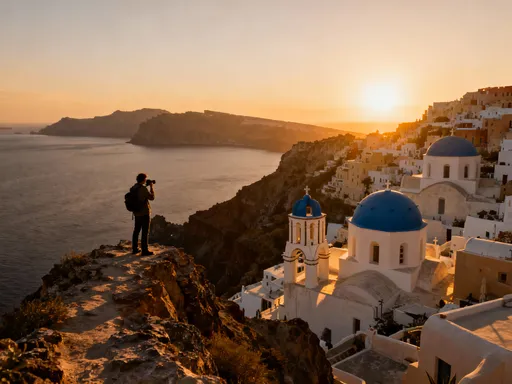
No viewpoint in Santorini is more celebrated than Oia, especially at sunset. Perched on the northern tip of the island, Oia offers a front-row seat to one of the most photographed sunsets in the world. The daily gathering of visitors along the castle ruins and narrow alleyways is a testament to its magnetic appeal. Yet, capturing a truly original image here requires more than just showing up. The key lies in preparation, positioning, and perspective. The Oia Castle, or the ruins of Agios Nikolaos, remains the most sought-after spot, but arriving at least 90 minutes before sunset is essential to secure a good vantage point without obstructed views.
While the classic wide-angle shot of the sun dipping behind the church domes is iconic, it has also become repetitive. To stand out, photographers should explore alternative angles—shooting from below the castle walls, framing the scene through doorways or arches, or focusing on silhouettes of couples and families against the fading light. The alleyways leading down to Amoudi Bay offer layered compositions, with cascading rooftops and winding staircases guiding the eye toward the horizon. A mid-range zoom lens (24–70mm) is ideal for balancing expansive views with intimate details.
Crowds can be overwhelming, but they also present storytelling opportunities. Capturing the anticipation on faces, the quiet moments before the sun disappears, or the reflections in shop windows adds narrative depth. For those seeking solitude, consider photographing the pre-sunset light when the golden glow bathes the village in warmth without the congestion. Early evening shots, after the main crowd disperses, reveal a more peaceful Oia, with warm interior lights beginning to flicker on. Respect for local residents is crucial—many homes double as guesthouses or shops, and intrusive photography should be avoided. The goal is not just to take a photo, but to honor the place and its people.
Fira to Firostefani: The Ridge Walk with Endless Frames
Connecting the island’s capital, Fira, with the quieter villages of Firostefani and Imerovigli, the caldera ridge path is a photographer’s dream come true. Stretching approximately three kilometers, this well-maintained trail offers continuous views of the volcanic islands in the center of the caldera—Nea Kameni, Palea Kameni, and the steam vents of the active volcano. Unlike Oia’s concentrated spectacle, this route provides a more gradual, immersive experience, with shifting perspectives at every bend. The elevation remains consistently high, ensuring unobstructed sightlines across the water.
Firostefani, midway along the route, is often overlooked but deserves attention. The village’s name means “the head of the mountain,” and its terraces offer some of the most balanced compositions of white buildings against the deep blue sea. The blue-domed Church of Three Hierarchs is a focal point, perfectly framed from multiple angles along the path. Because it’s less crowded than Fira or Oia, photographers can take their time composing shots without rushing. Early morning visits reveal soft light and minimal foot traffic, ideal for capturing stillness and reflection.
The ridge walk is particularly rewarding for those interested in architectural patterns and natural textures. The contrast between the smooth, curved walls of the houses and the jagged volcanic rock formations creates visual tension. Shadows play a significant role here—during midday, when the sun is high, long lines are cast across the whitewashed facades, adding rhythm and depth to compositions. A polarizing filter helps manage glare on both water and white surfaces, enhancing color saturation. For wide panoramas, a tripod and stitching technique can produce high-resolution images that do justice to the sweeping vistas. This route proves that Santorini’s beauty isn’t limited to sunset—it’s a 24-hour visual journey.
Imerovigli: The Hidden Gem for Solitude and Scale
If Oia is the island’s crown jewel and Fira its beating heart, then Imerovigli is its quiet soul. Located at the highest point along the caldera rim, this village offers the most dramatic elevation and some of the most expansive views. Often called the “balcony to the Aegean,” Imerovigli is less commercialized and significantly quieter than its neighbors, making it ideal for photographers seeking solitude and contemplative moments. The absence of large crowds allows for longer exposures, careful framing, and a deeper connection with the landscape.
The centerpiece of Imerovigli’s photographic appeal is Skaros Rock, a massive volcanic formation that juts out from the cliffside like a natural fortress. Once home to a medieval castle, the site now offers a challenging but rewarding hike. The trail down to Skaros is rocky and uneven, but the payoff is immense—uninterrupted 270-degree views of the caldera, the distant islands, and the open sea. At sunrise, the rock is often shrouded in morning mist, creating a mystical atmosphere perfect for moody, atmospheric shots. A wide-angle lens captures the scale, while a telephoto can isolate details like seabirds in flight or the textures of eroded lava.
Because Imerovigli is higher in elevation, it experiences slightly cooler temperatures and earlier light transitions. This means sunrise arrives a few minutes before other parts of the island, offering a unique opportunity to capture the first rays illuminating the cliffs from above. The village itself is dotted with boutique hotels and private terraces, some of which are accessible to guests and offer elevated shooting platforms. However, photographers must always respect private property and seek permission when necessary. The essence of Imerovigli lies in its stillness—here, photography becomes a meditative act, a way of slowing down and truly seeing.
Off-the-Beaten-Path Lookouts: Local Secrets Beyond the Crowds
While the caldera villages draw the majority of visitors, some of Santorini’s most authentic and visually striking viewpoints lie beyond the tourist trail. One such location is the trail leading to Prophet Elias Monastery, perched on the island’s highest peak at 567 meters. Accessible by car or a steady hike, the monastery offers a completely different perspective—one that looks *down* on the caldera rather than from within it. From this vantage point, the entire crescent shape of Santorini unfolds, with the deep blue of the sea encircling the volcanic islands. On clear days, the islands of Ios and Anafi are visible in the distance, adding depth to wide-angle compositions.
Another lesser-known gem is the coastal path near Akrotiri, on the southern tip of the island. Away from the caldera’s cliffs, this area reveals a different geology—red and black sand beaches, rugged lava formations, and the ancient Minoan settlement buried under volcanic ash. The lighthouse at Akrotiri Point is a quiet spot for sunset photography without the crowds of Oia. The interplay of light on the red rocks and the contrast with the turquoise water create a palette unlike any other part of the island. Because this area is less developed, photographers can explore freely, though care should be taken on uneven terrain.
The village of Megalochori, nestled inland, offers a glimpse into traditional Cycladic architecture without the overwhelming tourism infrastructure. Narrow cobblestone streets, arched doorways, and hidden courtyards provide intimate subjects for street photography. Similarly, the vineyards of Pyrgos and Exo Gonia showcase the island’s agricultural side, with low-lying stone walls and unique basket-shaped vines that protect grapes from the wind. These locations remind us that Santorini is not just a postcard—it is a living, working island with a rich cultural fabric. Visiting them requires a willingness to wander, to engage respectfully with locals, and to look beyond the obvious.
Photography Tips for Capturing Santorini’s Soul
To truly capture Santorini’s essence, technical preparation is as important as artistic vision. First, shoot in RAW format whenever possible. This preserves maximum image data, allowing for greater flexibility in post-processing, especially when balancing the extreme contrasts between white buildings and deep blue skies. A polarizing filter is indispensable—it reduces glare on water and white surfaces, enhances cloud definition, and deepens the blue of the sky without oversaturation. However, it should be used carefully, as over-polarization can create unnatural dark patches in wide-angle shots.
White balance is another critical setting. Auto white balance often struggles with the abundance of white and blue, resulting in cool, bluish tones. Switching to “Cloudy” or “Shade” mode can introduce warmth that better matches the golden light of Santorini. For more control, manually set the color temperature around 5500–6500K, depending on the time of day. Bracketing exposures—taking multiple shots at different settings—ensures that highlight and shadow details are preserved, especially in high-contrast scenes like midday on the caldera rim.
Lens choice depends on the desired effect. A wide-angle lens (16–35mm) is essential for capturing vast panoramas and emphasizing the scale of the landscape. A mid-range zoom (24–70mm) offers versatility for both environmental portraits and architectural details. A telephoto lens (70–200mm) allows for compression and isolation of distant subjects, such as the dome of a church framed against the sea. A tripod is highly recommended for long exposures, especially during golden hour or twilight, when shutter speeds slow down.
Equally important is ethical photography. While social media has made dramatic poses on cliff edges popular, these can be dangerous and disrespectful. Many overlooks have no railings, and a misstep can be fatal. Photographers should never risk safety for a shot. Additionally, private homes, family gatherings, and religious sites should be approached with sensitivity. Always ask before photographing people, and avoid intrusive behavior. True photography is not about conquest—it’s about connection.
Beyond the View: Connecting with Place Through the Lens
Photography, at its best, is not just about capturing images—it’s about deepening one’s experience of a place. In Santorini, the act of composing a shot—waiting for the right light, adjusting the angle, noticing the way shadows fall across a wall—forces a slowing down, a mindfulness that transforms tourism into something more meaningful. It encourages travelers to look closer, to see beyond the postcard, and to engage with the rhythm of daily life. The sound of church bells, the scent of jasmine in courtyards, the warmth of a local’s smile—these are the elements that give a photograph soul.
When we photograph with intention, we move from being spectators to participants. We begin to notice the small details—the way a fishing boat bobs in Amoudi Bay, the pattern of a hand-painted sign, the texture of volcanic stone underfoot. These moments, when framed with care, tell a richer story than any clichéd sunset could. They reflect not just what Santorini looks like, but what it feels like. And in doing so, they honor the island’s true spirit.
As travelers, we have a responsibility to preserve the beauty we seek to capture. This means treading lightly, respecting local customs, and avoiding behaviors that degrade the environment or exploit communities for the sake of a viral image. Santorini is more than a backdrop—it is a living culture, shaped by history, resilience, and connection to the sea. By photographing with integrity, we contribute to its preservation rather than its commodification.
So pick up your camera, but also put it down. Walk the quiet paths, talk to the locals, savor a cup of Greek coffee on a terrace overlooking the caldera. Let the island reveal itself in its own time. Because the most powerful images are not just seen—they are felt. And in Santorini, where light, land, and sea converge in perfect harmony, every photograph has the potential to be a moment of wonder, a tribute to a place where dreams meet reality.